Lisbon / Louis Cane - Works 1966-68 / ILHA
28 May - 30 June, 2026
In the late 1960s, the Supports/Surfaces movement emerged in France under the impulse of three young artists, Louis Cane, Daniel Dezeuze, and Claude Viallat, who sought to fundamentally reassess the nature and conditions of
painting. Advocating for the liberation of the canvas from its stretcher, they initiated a radical inquiry into the material, structural, and conceptual parameters of the pictorial field. The movement was soon joined by Vincent Bioulès, Bernard Pagès, Patrick Saytour, Noël Dolla, Jean-Pierre Pincemin, and Marc Devade, among others.
While adopting the formal sobriety associated with American Minimalism, Supports/Surfaces distinguished itself through a pronounced critical and ideological dimension, grounded in a pervasive deconstruction of the pictorial medium. Painting was thereby desacralized, its traditional hierarchies dismantled in favor of an investigation into its constitutive elements. The movement’s theoretical underpinnings were informed in part by Structuralism, a dominant intellectual paradigm in France during the 1960s.
Within this framework, the artists undertook to question the act of painting to its core, in a manner analogous to the analysis of linguistic systems. The artwork was thus conceived not as the expression of individual subjectivity, but as a set of relations between its material and formal components.
Consequently, figuration and illusionistic depth were unequivocally rejected.
Painting no longer sought to represent an external reality ; rather, it asserted its own material conditions of existence, foregrounding process, support, and surface. The canvas, divested of its traditional status, was removed from its stretcher, folded, suspended, or fragmented. Fabrics were painted, knotted, and directly affixed to the wall, while the frame was either eliminated or presented as an autonomous, self-sufficient element.
The Supports/Surfaces movement is characterized by the use of simple, raw materials and a rejection of traditional “noble” artistic media, aligning it with Arte Povera, which developed contemporaneously in Italy within a broader context of political and social upheaval across Europe.
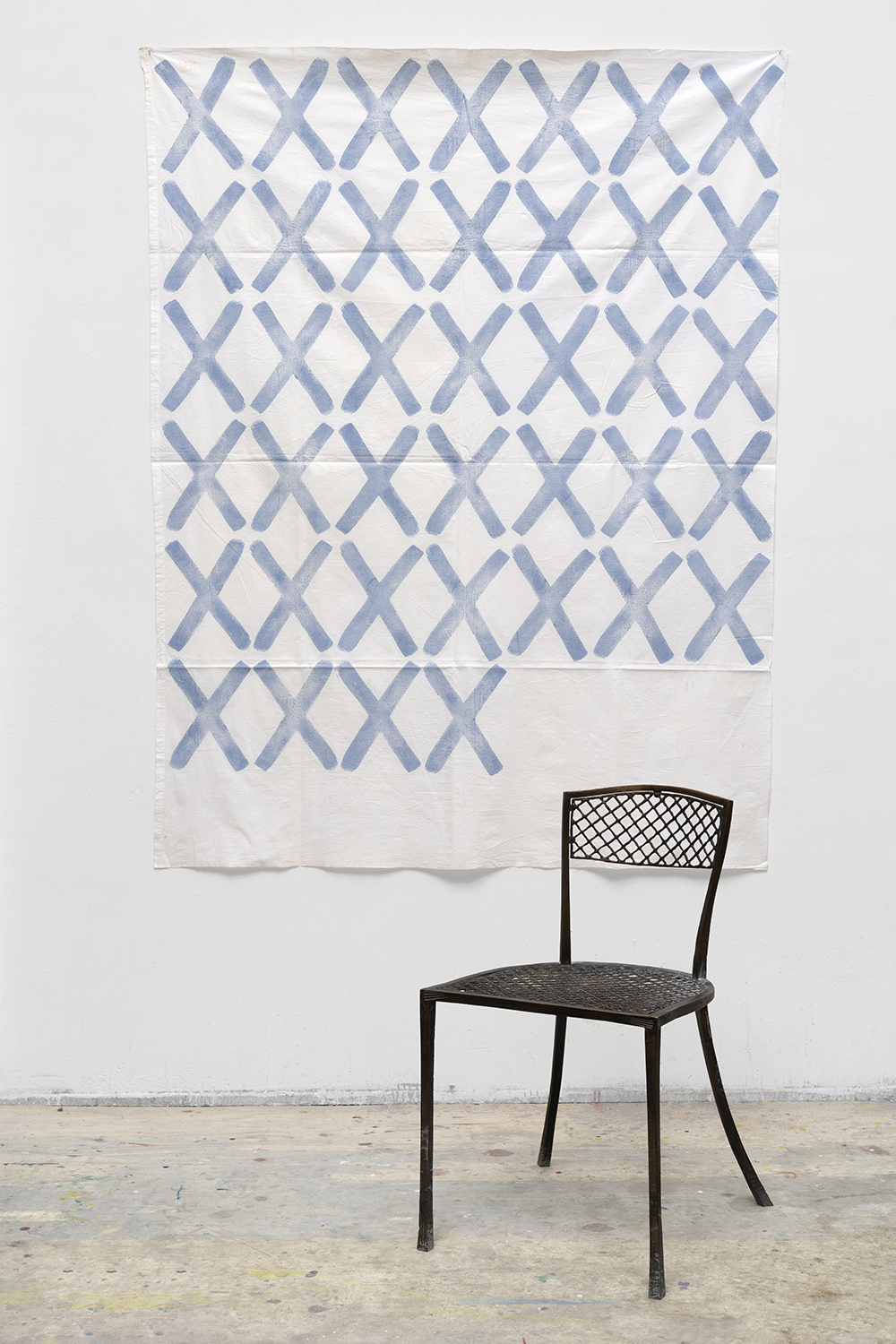
Initiated in 1966 this series foregrounds the significance of the X motif in Louis Cane's work and exemplifies the key principles of this French avant-garde movement. Produced between 1966 and 1968 and first presented in Portugal, at ILHA, these works stand at the crossroads of American Minimalism seen in their elementary gestures and repetition and a conceptual, analytical approach influenced by Arte Povera.
These works also illustrate Louis Cane’s deep attraction to color. A great colorist, he frequently reinterpreted the hues of Très Riches Heures du Duc de Berry, notably making blues a central and essential element of his work.
Red, sky blue, turquoise, and black X-shaped forms are stamped onto canvas or fabric and affixed directly to the wall, floating freely in space, liberated from the constraints of the stretcher. Colour introduces a vital presence that
counterbalances the austerity of the repeated gesture.
Several pieces of furniture in bronze are also included in the exhibition, subtly underlining the dialogue between the artist’s practice and the one of the designer.
An essay by New York critic and curator Bob Nickas accompanies the exhibition.